
Regular

Books
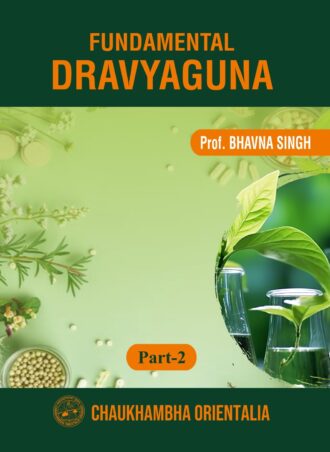
Fundamental Dravyaguna (Vol.2) (NCISM Syllabus)
Fundamental Dravyaguna-Part 2 is a concise, high yield guide tailored specifically to the latest NCISM Paper 2 Syllabus for B.A.M.S (2nd year) Ayurveda students. The book systematically covers the two core pillars of the curriculum: Bheshajavacharaniya and Detailed Study of Dravyas. By utilizing high-quality plant photographs, flowcharts, and comparative tables, this text transforms complex Ayurvedic pharmacology into a visually intuitive, easy-to-grasp resource.
Key Features
. Syllabus-Aligned Clarity: Fully covers the NCISM Paper 2 Syllabus for Dravyaguna Vigyan, balancing baseline knowledge with up-to-date academic insights.
. Visual Learning Aid: Packed with actual plant photographs for easy botanical identification, alongside charts and pictographs designed to boost memory retention.
. High-Yield & Concise: Focuses on essential details to make quick revision efficient and stress-free before examination.
. Exam-Ready Practice: Includes a dedicated bank of Multiple choice Question (MCQs), Short-answer question, and long-answer questions to help students self-assess and practice.
. Accessible Language: Written in a simple, Lucid style that makes the intricate principles of Ayurveda easily understandable for reader at all levels.
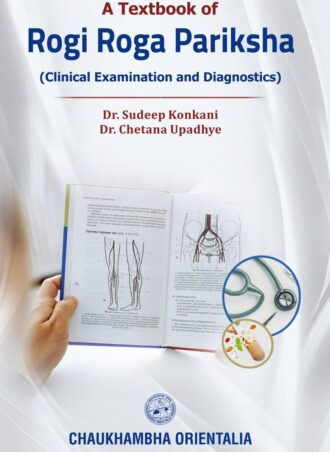
A Textbook of Rogi Roga Pariksha
A Comprehensive Manual of Clinical Diagnosis in Ayurveda: Integrating Rogi Pariksha and Modern Examination.
In the practice of medicine, a correct diagnosis s the ultimate foundation of successful treatment. This comprehensive textbook serves as a definitive clinical manual for both undergraduate and postgraduate students, bridging classical Ayurvedic diagnostic methods (Rogi-Roga Pariksha) with modern clinical systems and diagnostic tools.
The book is meticulously structured into two primary domains:
Classical Ayurvedic Diagnostics (Pariksha): A deep exploration of traditional examination methods rooted in antiquity, tracing from the Atharva Veda to the foundational frameworks of Charaka, Sushruta, and Vagbhata. It details the nuances of Trividha (three-fold), Shadvidha (six-old), Ashtavidha (eight-fold), and Dashavidha Pariksha (ten-fold clinical examination). Readers will find exhaustive guide maps on evaluating Deha Prakriti (biophysical constitution), Manasa Prakriti (psychic faculties), Sara (issue excellence), and Vikriti (morbidity profiles).
.Systemic & Modern Diagnostics: Translating ancient wisdom info modern practice, the second half focuses on the structured physical examination of major human systems including Respiratory, Gastrointestinal, Nervous, Musculoskeletal, and Urinary systems. Furthermore, it incorporates an essential introduction to contemporary diagnostic modalities such as X-ray, Ultrasound (USG), CT scan, MRI, ECG, and EEG.
Written with textual precision and enriched by classic Shlokas alongside comparative modern viewpoints, this book is indispensable diagnostic companion for every aspiring Ayurvedic physician, clinical researcher, and practitioner aiming for clinical excellence.
Key Features
.Complete Clinical Methodology: Thorough breakdowns of Darshana (Inspection), Sparshana (Palpation), and Prashna Interrogation) applied step-by-step to complex diseases like Pakshaghata (Hemiplega). .Prognostic Insights: Practical explanations of advanced diagnostic tools like Taila Bindu Pariksha (Urine drop test)and Nadi Pariksha (Pulse diagnosis).
.Scannable Reference Tables: Symptom correlation mattices connecting distinct sensory observations (taste, sound, smell, appearance)to specific pathological states.
.Integrated Approach: A smooth transition from the ancient Karanadi Dashavidha Parikshya Bhava to contemporary imaging
Tantra Yukti Workbook (NCISM Syllabus)
This workbook is specifically designed to help beginners achieve the first course outcome (CO1) of the NCISM Samhita Adhyayan-1 syllabus for BAMS. To ensure maximum accessibility for both slow and fast learners, the book simplifies the primary meaning of each Tantrayukti by grouping related concepts together rather than following the traditional classical order. It strategically limits its examples to familiar shlokas from Samhita Adhyayan-1, Padartha Vijnana, Kriya-sharira, and Rachana-Sharira. Furthermore, the content prioritizes the most apt definitions and explicitly emphasizes Chakrapani’s Ayurveda Deepika commentatry on the Charaka Samhita to align perfectly with academic and examiner expectations, while still providing alternative classical perspectives for broader context.
Research Methodology & Health Statistics (NCISM Syllabus)
Research Methodology and Biostatistics for Final Professional BAMS Students has been meticulously designed in accordance with the latest NCISM syllabus, with the aim of providing Comprehensive and student-friendly guidance on research and statistical concepts in Ayurveda education. The book covers all prescribed syllabus points in an elaborate yet simplified manner, supported by relevant examples, practical applications, flowcharts, tables, and topic-wise illustrations to enhance conceptual understanding.
Special emphasis has been given to examination-oriented preparation by systematically organizing the content into long answer questions, short answer question, and multiple-choice questions (MCQs). Each chapter includes specifically designed topic-wise questions, enabling students to develop a clear understanding of core concepts while improving their academic performance and competitive examination readiness.
Practical Activity Book of Shalya Tantra (NCISM Syllabus)
The Practical Activity Book of Shalya Tantra has been meticulously developed as a comprehensive practical manual for Third Professional B.A.M.S students, strictly adhering to the Competency-Based Undergraduate Curriculum (CBUG) prescribed the National Commission for Indian System of Medicine (NCISM).
Practical training forms the cornerstone of medical education, transforming theoretical understanding into clinical competence. In Shalya Tantra, this transition assumes even greater significance, as students are expected to acquire not only sound academic knowledge but also the technical skills, clinical judgment, professional ethics, and confidence essential for the practice of Ayurvedic surgery. Recognizing this need, the present activity book has been designed to provide a structured and competency-oriented approach to practical learning.
A Textbook of Agada Tantra Evam Vidhi Vaidyaka (NCISM Syllabus)
Agada Tantra Evam Vidhi Vaidyaka is comprehensive textbook specially designed according to the latest NCISM Curriculum for BAMS students. The book presents classical Ayurvedic toxicology and forensic medicine in a simplified, systematic, and student-friendly manner, making it highly useful for undergraduate learning, university examination and competitive preparation.
The content has been arranged in accordance with the updated syllabus pattern, integrating both traditional Ayurvedic Principal arranged in accordance with the updated syllabus pattern, integrating both traditional Ayurvedic Principles and modern medico-legal concepts. Special emphasis has been given to conceptual clarity, practical applicability, and examination-oriented presentation.
Salient Features of the Book
. Strictly based on the new NCISM syllabus
. Simple and easy-to-understand language
. Comprehensive coverage of Agada Tantra and Vidhi Vaidyaka
. Inclusion of both Ayurvedic and modern forensic concepts
. Well-Structured Chapter-wise format
A Textbook of Agada Tantra Evam Vidhi Vaidyaka (NCISM Syllabus)
The Textbook of Agadatantra is compiled and written as per the new NCISM syllabus for 2nd BAMS students, this book is an attempt to compile all the subject point of syllabus from different text books, reference books and original Samhitas. The point of Forensic medicine and jurisprudence were collected similarly from modern books and relevant websites. as the scope and matter are very less available in the field of Ayurved and its literature. this book will certainly help U.G. students and P.G Scholars during their studies to learn the subject.
Dravyaguna Vigyan (vol.1) (NCISM Syllabus)
प्रस्तुत पुस्तक द्रव्यगुण विज्ञान प्रथम प्रश्नपत्र बी.ए.एम.एस. द्वितीय व्यावसायिक छात्रों हेतु एन.सी.आई.एस.एम. के नवीन पाठ्यक्रम पर आधारित है। इसमें नवीन पाठ्यक्रमानुसार सभी विषयों को यथासम्भव सभी शास्त्रीय संदर्भों सहित बहुत ही सरल एवं सुन्दर ढंग से प्राचीन एवं आर्वाचीन मतानुसार प्रस्तुत करने का प्रयास किया गया है।
नवीन पाठ्यक्रम में कुछ नये विषय जैसे- जी.सी.पी., एन.एम.पी.बी.. सी.सी.आर.ए.एस., ए.पी.आई., जी.सी.टी.एम.,
पी.सी.आई.एम.एच.,वृक्षायुर्वेद, नेटवर्क फार्मेकोलॉजी आदि जोड़े गये हैं इनका भी वर्णन अलग-अलग अध्यायों में प्राचीन एवं वैज्ञानिक मतानुसार किया गया है। इस पुस्तक में पाठ्यक्रम का मुख्य भाग “सामान्य फार्मेकोलॉजी के सिद्धान्त” का वर्णन स्वतन्त्र अध्याय में विस्तृत रूप से किया गया है। पुस्तक की भाषा सरल एवं हृदयग्राही है जो छात्रों के मन मस्तिष्क पर एक अलग छाप छोड़ेगी।
A Textbook of Swasthavritta and Yoga (NCISM Syllabus)
The Purpose of this book is to bring comprehensive textbook of Swasthavritta and Yoga for Undergraduate students of Ayurveda. The book is greatly complemented for its content, coverage and treatment of the subject with latest competency based on strictly adhering to apex body syllabus of CBDC with point point- to-point explanation by referring maximum available literature with authentic references of both Ayurveda and Contemporary medicine.
Highlights of the book
. The uniquessof this text is having introduction section which is a highlight for this book which covers all the references of Swasthavritta from Vedas to Contemporary period.
.The book has written strictly adherent to CBDC curriculum prescribed by NCIM.
The is the outcome of 28 years of rich experience in academics (UG & PG).
Written in a lucid and easy to read style in a sequential manner and systematically.
A Textbook of Shalya Tantra (Vol. 1) (NCISM Syllabus)
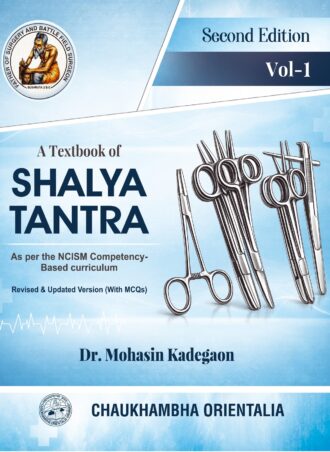
❖ Strictly aligned with the latest NCISM Competency-Based BAMS Curriculum. ❖ Structured in simple, exam oriented language for conceptual clarity and rapid revision. ❖ 20 years of University Examination Questions compiled chapter-wise. ❖ Comprehensive inclusion of MCQs, LAQs, and SAQs for structured self-assessment. ❖ Most important viva questions highlighted with star marking for quick recall. ❖ More than 550+ high resolution colour photographs, clinical images and surgical illustrations. ❖ 350+ High-Yield Tables for rapid memorization and conceptual reinforcement. ❖ Covers extensive content beyond undergraduate level useful for Postgraduate Entrance Preparation. High quality clinical photographs, operative diagrams, flowcharts and procedural algorithms. ❖ Clear hierarchy of headings, subheadings, bullet points and boxed summaries. ❖ Key Points Boxes at the beginning of every chapter for focused study. ❖ PG level previous question papers (last 5 years) with important topics, clinical signs, triangles, operations, sites of disease, tests, deformities, misnomers and triads in clinical examination have been mentioned. ❖ Thoroughly revised and academically validated by experienced Shalyatantra faculty. ❖ Basic surgical concepts of Sushruta are compiled and explained in interesting and easy way. A sincere attempt is made for some modern diseases with Ayurvedic management based on the clinical experience. ❖ QR codes are provided throughout the book for additional explanation through videos.
Digital Tools and Datamining in Dravyaguna (Mitanshimanimala)
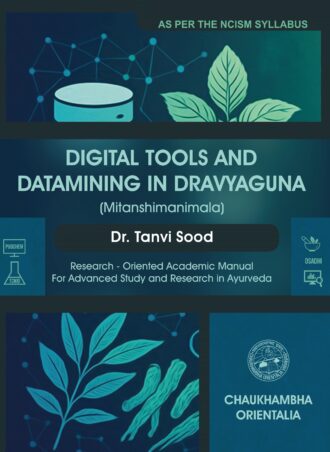
Mitanshimanimala is designed in a structured academic format aligned with the new NCISM MD Dravyaguna curriculum, while also serving as a foundation for postgraduate research training and support for Research Methodology learning in Ayurveda. It guides students and scholars in developing research questions, identifying topics with thesis performing systematic database-driven data analysis, and interpreting findings scientifically. Step-by-step methodologies lead learners from database exploration to hypothesis generation and research design- core skills essential for academic learning, Research Methodology training, and dissertation preparation.
Dravyaguna Activity Manual
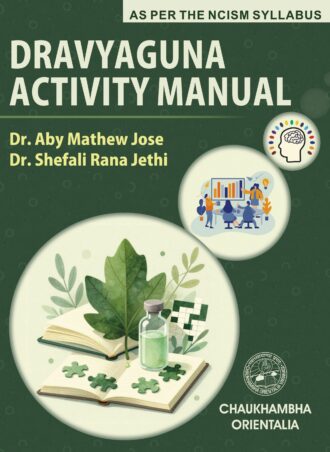
This book has been prepared in accordance with the activity-based learning approach prescribed by the NCISM for the subject Dravyaguna Vigyana at the second-year B.A.M.S. level. Recognizing the importance of practical understanding in Ayurveda, the activities designed by NCISM aim to strengthen not only the theoretical foundations but also the experiential learning of students.
Dravyaguna Samucchaya
Dravyaguna Samucchaya is a comprehensive book covering required information about all the three categories of raw materials used in Ayurvedic
